
The Data Revolution in Personal Finance
For decades, traditional retail banks operated like high-security fortresses. They did not just guard your physical cash; they held an absolute monopoly over your financial data. Your transaction history, your spending habits, your savings patterns, and your credit worthiness were locked away behind proprietary banking infrastructure. If you wanted to share that data with a third-party app or a alternative financial service, the process was clumsy, insecure, and often flatly discouraged by major institutions.
A quiet regulatory and technological shift is permanently tearing down those fortress walls. This movement is known as Open Banking. At its core, open banking is a secure framework that forces financial institutions to share your financial data with authorized third-party providers—but only if you explicitly grant permission. This article explores the mechanics of open banking, the security infrastructure that protects your information, and how this data revolution is reshaping the consumer financial landscape.
Decoding the Mechanics: How Open Banking Works
To understand open banking, it helps to understand the concept of data ownership. Historically, banks acted as if they owned your financial records. Open banking flips this paradigm on its head, asserting that you own your financial data, and your bank is merely the custodian.
The technical engine driving open banking is the Application Programming Interface (API). An API is a software intermediary that allows two distinct applications to communicate and share information with one another securely in real time.
Before open banking APIs became the global standard, financial apps relied on a highly flawed practice called Screen Scraping. If you wanted a budgeting app to track your expenses, you had to provide that app with your actual online banking username and password. The app would then log into your account pretending to be you, scraping the text off the screen to read your transactions. Screen scraping is structurally insecure, leaves your master credentials vulnerable to data breaches, and gives third-party apps unrestricted access to your account.
Open banking completely replaces screen scraping with dedicated APIs. When you link a modern financial application to your bank account today:
- The app redirects you to your bank’s official portal or secure mobile application.
- You authenticate your identity directly with your bank using biometrics or multi-factor authentication.
- You grant specific, granular permissions (e.g., “allow this app to view my account balance and transaction history for the next 90 days”).
- Your bank issues a secure, encrypted digital token to the third-party app.
The third-party app never sees your login credentials, it cannot access information you did not authorize, and you can revoke its data access token instantly at any time through your banking dashboard.
The Global Regulatory Landscape
Open banking is rolling out across the world through two primary pathways: regulatory mandates and market-driven innovation.
- The United Kingdom and Europe (Regulatory-Driven): Europe is the undisputed birthplace of formalized open banking regulations. The European Union implemented the revised Payment Services Directive (PSD2), while the UK established the Open Banking Implementation Entity (OBIE). These regulations legally mandated that banks must build secure APIs to share account data and facilitate payments for authorized third-party fintech companies.
- The United States (Market-Driven): For years, the US took a market-led approach, where financial technology companies and banks formed private agreements to exchange data. However, the regulatory environment has caught up, with the Consumer Financial Protection Bureau (CFPB) formalizing rules under Section 1033 of the Dodd-Frank Act to officially establish clear open banking rights and secure data portability standards for American consumers.
- Australia and Beyond: Australia implemented the Consumer Data Right (CDR), which expands the open banking concept beyond finance, giving consumers the right to control and port their data across utilities, telecommunications, and energy sectors.
How Open Banking Benefits You
Open banking is not just an abstract technical upgrade; it delivers tangible everyday financial benefits to consumers.
- Hyper-Personalized Budgeting and Wealth Management: Instead of manually logging into four different credit cards, two investment accounts, and a primary checking account, open banking aggregates your entire financial life into a single dashboard. AI-driven apps analyze this data in real time, pinpointing hidden subscription fees, identifying wasteful spending habits, and offering automated savings strategies customized to your income cycles.
- Democratized Credit and Automated Lending: Traditional credit scoring models are heavily reliant on rigid history metrics, often alienating younger consumers, immigrants, or freelancers. Open banking allows lenders to look beyond a simple credit score. By securely analyzing your real-time income streams, utility payment consistency, and day-to-day cash flow patterns, lenders can approve mortgages and personal loans with fairer interest rates and higher accuracy.
- Smarter Product Comparison: Open banking marketplaces can scan your actual checking account data and match you with financial products that save you money. For instance, an automated platform can analyze your average savings balance and instantly inform you that a rival institution is offering a significantly higher yield, helping you seamlessly switch accounts.
Navigating the Risks: Privacy and Data Security
While the benefits of open banking are immense, handing financial data access to third-party applications naturally raises valid privacy and security concerns. The integrity of the open banking ecosystem rests on strict regulatory oversight.
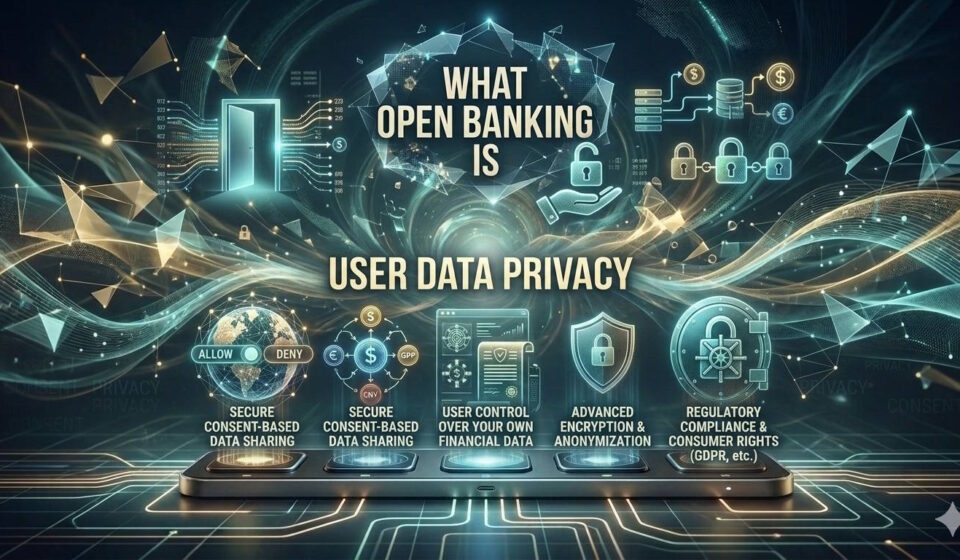
Third-party providers operating in an open banking ecosystem must undergo rigorous vetting, licensing, and auditing by government financial authorities. They are bound by strict data privacy laws (such as GDPR in Europe) that dictate how financial data can be used, stored, and anonymized.
Furthermore, open banking introduces Account Information Services (AIS) and Payment Initiation Services (PIS). While AIS only allows an app to read your transaction data, PIS allows an authorized app to actually initiate payments directly from your bank account. Because PIS bypasses traditional card networks, it requires a high degree of consumer trust and robust multi-factor authentication protocols to prevent unauthorized fund movements.
The Future: Moving Toward Open Finance
Open banking is merely the foundational first step of a much larger economic transformation. The ultimate goal is a transition from open banking to Open Finance, and eventually, a fully realized Open Data Economy.
In an open finance framework, data portability will expand beyond checking and savings accounts. Consumers will have the power to seamlessly securely share data from their insurance policies, mortgage contracts, stock portfolios, and retirement pensions. The ultimate destination is a completely transparent, frictionless financial world where data silos are eliminated, and consumers hold absolute control over their economic destinies.