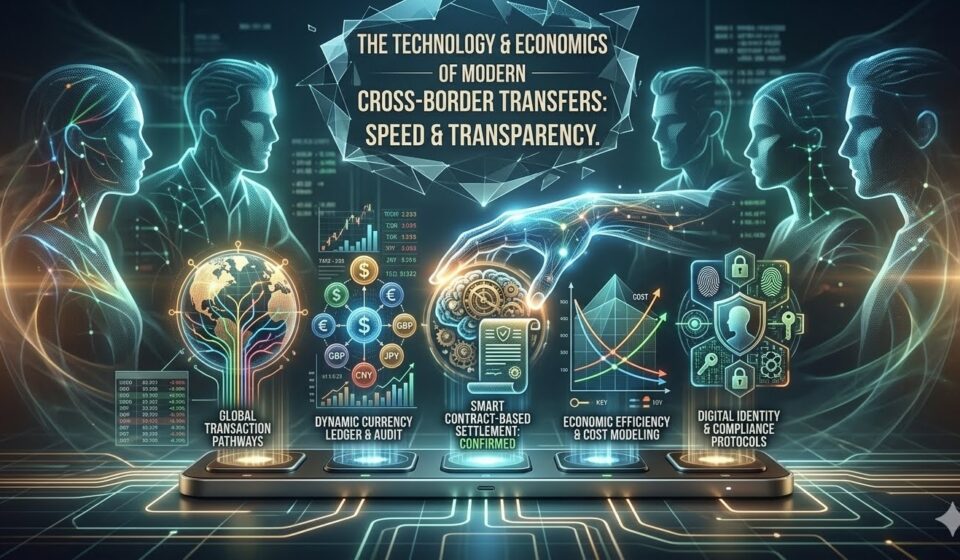
Breaking Borders: The Technology and Economics of Modern Cross-Border Transfers

The Silent Engine of Global Commerce
Every single day, trillions of dollars cross international borders. A parent in Spain sends tuition money to a daughter studying in Japan. A freelance graphic designer in Colombia receives payment from a corporate client in Germany. A migrant worker in the United States sends a portion of their weekly paycheck back home to family in rural Mexico.
Cross-border transfers are the silent engine powering the modern globalized economy. Yet, for decades, moving money between different countries, currencies, and regulatory jurisdictions was notoriously slow, hidden behind exorbitant fees, and shrouded in administrative mystery. Today, a digital-first financial ecosystem is dismantling these traditional barriers. This article explores the evolution of international money transfers, the inner workings of global payment networks, and how technology is bringing financial systems closer together.
The Traditional Blueprint: Understanding the Legacy Network
To appreciate the speed and efficiency of modern money transfer services, it is helpful to look at how international banking traditionally operated—and in many cases, still does. For over half a century, the global standard for international wire transfers has been SWIFT (the Society for Worldwide Interbank Financial Telecommunication).
SWIFT does not actually move money. Instead, it is a secure messaging network that transmits financial instructions between member banks. When you initiate a traditional international bank wire, your funds do not travel instantly across an ocean. Instead, the transaction relies on a system known as Correspondent Banking.
If Bank A in New York does not have a direct financial relationship with Bank B in Nairobi, the money must pass through a chain of intermediary banks (correspondent banks) that hold accounts with one another. Each intermediary bank along the path processes the transaction, takes a processing fee, and introduces potential delays. This legacy framework explains why a traditional international wire transfer can take anywhere from three to five business days to clear, and why the final amount received often differs from the amount originally sent.
The True Cost of Moving Money: Fees and FX Markups
When consumers or small business owners look to transfer funds globally, they face two distinct, often hidden, financial charges:
-
- The Upfront Transfer Fee: This is the flat charge or percentage fee that the bank or transfer provider openly states at the start of the transaction.
- The Foreign Exchange (FX) Markup: This is where the true cost of an international transfer is frequently hidden. Financial markets trade currencies using the mid-market exchange rate (the exact midpoint between the buy and sell prices of a currency). However, traditional institutions rarely offer this rate to retail consumers. Instead, they apply a “markup” or spread to the exchange rate.
For instance, if the actual mid-market rate for 1 USD is 0.92 EUR, a traditional provider might offer you a rate of 1 USD to 0.88 EUR, quietly pocketing the difference. When multiplied across thousands of dollars, these hidden FX markups can drain significant capital from individuals and businesses alike.
The Digital Disruption: Fintech Challengers Take the Stage
Over the past decade, financial technology (fintech) platforms have disrupted the remittance and cross-border payment landscape. Companies like Wise (formerly TransferWise), Revolut, and Remitly re-engineered the mechanics of international money movement.
Instead of sending money across borders via expensive intermediary networks, these fintech platforms built domestic banking networks worldwide. For example, if you want to send USD from the United States to Great Britain (GBP) using a modern fintech provider, the process works locally:
-
- You deposit USD into the fintech company’s local United States bank account.
- The company’s automated system verifies the transfer.
- The fintech company then uses its own local British bank account to distribute the equivalent amount in GBP directly to your recipient.
The money never actually crosses an international border. It stays within local banking loops. By bypassing the traditional correspondent banking network completely, these platforms can offer near-instantaneous transfer times and give consumers access to the true mid-market exchange rate, charging only a transparent, upfront fee.
Regulation, Security, and Compliance
As international money transfers become faster and more accessible, ensuring the security of these transactions is paramount. Because cross-border payments can be exploited for illegal activities, financial institutions must navigate an intricate web of global regulations.
The cornerstone of modern transfer security rests on two regulatory pillars: KYC (Know Your Customer) and AML (Anti-Money Laundering). Before allowing a user to send significant sums of money overseas, digital platforms must verify the sender’s identity using government-issued IDs, facial recognition scans, and proof of address.
Advanced machine-learning algorithms monitor transaction patterns in real time. If a transfer looks anomalous—such as an unusual destination country or an unexpected surge in transaction volume—the system flags it for review to prevent fraud, identity theft, and terrorist financing. While these security checkpoints can occasionally cause temporary transaction delays, they are vital for protecting the integrity of the global financial ecosystem.
The Horizon: Web3, Stablecoins, and CBDCs
The evolution of cross-border transfers is accelerating toward a completely instantaneous future. The integration of blockchain technology and digital assets is reshaping our understanding of how value moves across borders.
Stablecoins—digital tokens pegged directly to the value of fiat currencies like the US Dollar or the Euro—are increasingly used to settle international transactions. Because stablecoins operate on public or private blockchains, funds can be transferred directly from sender to receiver in seconds, 24/7, completely bypassing traditional banking hours and settlement delays.
Concurrently, central banks around the globe are developing Central Bank Digital Currencies (CBDCs). Unlike decentralized cryptocurrencies, CBDCs are digital representations of a country’s sovereign currency, backed directly by the government. When fully realized, interconnected CBDC networks could allow different nations to settle cross-border transactions instantaneously, securely, and at practically zero cost.
The era of waiting days for an international wire and losing hard-earned money to hidden bank fees is ending. The future of cross-border transfers is transparent, instant, and borderless.